Build one polished event page, set clear contribution goals, write your ask with gratitude, route guests to secure checkout, and confirm your withdrawal plan before you send a single invite. That’s the whole nonprofit business plan for a cash-gift milestone event: one hub, transparent goals, and a payment path that gets money from your guests’ pockets into your bank account without confusion on either end.
Before you share your event page anywhere, get these pieces in place:
- Pick your goal structure (one pooled fund or a few named items).
- Write your ask in warm, optional language.
- Confirm your checkout runs through a secure processor.
- Know your withdrawal timeline and verification requirements.
Rodrigo, who covers cash-gift planning for the Zelo blog, built this checklist around the same operational steps hosts use on Zelo, a cash-gifting platform for weddings, birthdays, baby showers, and other milestones.
Key Takeaways
A milestone cash gift event succeeds when one event page combines clear goals, gracious wording, secure checkout, and a verified withdrawal plan.
| Point | Details |
|---|---|
| One source of truth | Point every invitation and reminder to a single event page URL to avoid scattered messages. |
| Mix your price points | Offer low, mid, and high contribution tiers so guests of every budget can participate. |
| Keep links off formal invites | Place registry links on your event website, not the wedding invitation itself. |
| Know your net, not just your gross | Check the platform and processor fee breakdown at checkout so a $100 gift’s real value is no surprise. |
| Verify banking details early | Complete ID and bank verification before you need to withdraw funds, since it can take several business days. |
| Zelo handles the operational side | Zelo combines event pages, goal tracking, PayPal checkout, and guest messaging in one platform built for milestone cash gifts. |
Table of Contents
- Nonprofit Business Plan Basics: The Pre-Launch Checklist
- How Should You Structure Contribution Goals?
- What’s the Polite Way to Ask for Cash Gifts?
- How Do Payments and Withdrawals Actually Work?
- Is Your Event Page Actually Secure?
- When Should You Ask and Send Thank-Yous?
- What Actually Matters Once the Ask Is Live
- Set Up Your Cash Gift Page With Zelo
- Frequently Asked Questions
- Sources
Nonprofit Business Plan Basics: The Pre-Launch Checklist
Most planning mistakes happen because hosts skip sequencing and jump straight to sharing a link. A short pre-launch order fixes that.
- Decide single vs. multiple goals. A pooled “celebration fund” works for open-ended events; named goals (honeymoon, house down payment, a charity donation, a specific experience like a cooking class) work better when guests want to know exactly where their gift lands.
- Set contribution tiers. Suggested amounts like $25, $50, and $100 let a coworker and a close relative both give comfortably, echoing the etiquette guidance that a mix of price points makes registries more inclusive of every guest’s budget.
- Designate one source-of-truth URL. Every invitation, text, and reminder should point to the same event page, never to five different group chats.
- Assign roles. Decide who writes guest messages, who confirms banking and verification details, and who tracks thank-you notes.
Pro Tip: Lock in your goal amounts before you write any invitation copy. Changing numbers after guests have already seen them creates confusion and makes tracking thank-yous harder later.
How Should You Structure Contribution Goals?
A pooled fund keeps things simple: one number, one progress bar, no guest guessing which item their $40 covered. Named goals give guests more emotional connection, since “help fund our honeymoon flights” lands differently than “general gift fund,” but they require more setup and more updates as each goal fills.
Whichever structure you pick, break it into suggested amounts rather than one large target. A $3,000 honeymoon goal feels distant; “$50 covers a dinner in Rome” feels achievable.
- Use a visible progress bar so guests see momentum, not just a static ask.
- Mark items as funded or fulfilled so nobody keeps contributing to a goal that’s already met.
- Write a short line explaining exactly how funds will be used (“Every gift here goes toward our first home together”).
Registries with mixed price points see higher overall participation than those listing only high-ticket items, according to Emily Post’s shower registry guidance. A $20 option matters as much as a $200 one.
What’s the Polite Way to Ask for Cash Gifts?
Placement rules differ by event type. Weddings and showers are the two occasions where registries are traditionally expected, but etiquette still says keep the registry link off the formal invitation itself and place it on your event website instead. Birthdays and graduations have more flexibility since there’s no formal invitation tradition to navigate.
- For weddings, list your registry link on the wedding website, not the invitation card.
- For showers, a simple line in the digital invite or a shared link works fine since expectations are more casual.
- For birthdays and anniversaries, direct guests to the event page in your text or email invite.
Sample wording that works: “Your presence means everything. If you’d like to contribute to our next chapter, you’ll find details on our page.” Cash requests read as generous rather than presumptuous when the language stays optional and the purpose is clear, according to a Los Angeles Times wedding registry guide.
For older guests who prefer giving something tangible, offer one or two small physical registry items alongside your cash goals. That keeps the option open without complicating your main ask.
Pro Tip: Keep every version of your ask, from the invitation line to your group text, pointing to one URL. Guests who get a different link from a different relative start to wonder which one is current.
How Do Payments and Withdrawals Actually Work?
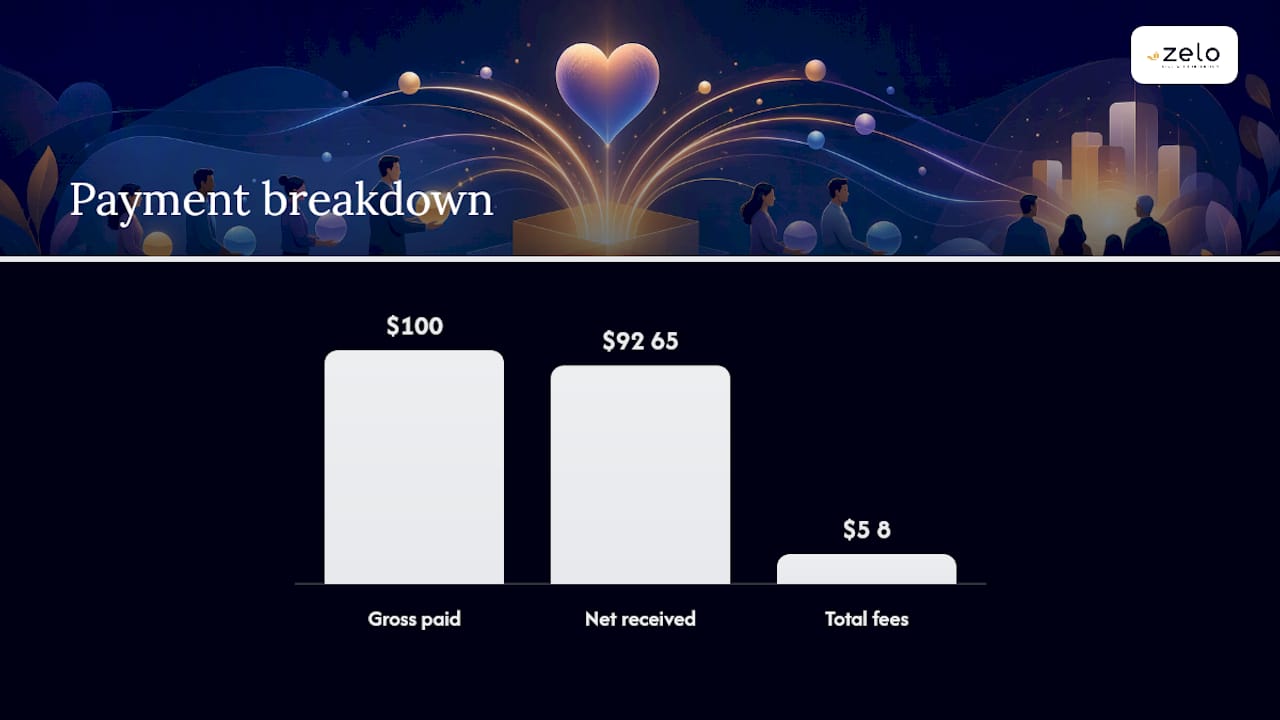
Money moves in a predictable sequence: a guest pays through checkout, the platform and payment processor each take a small cut, and the remainder lands in your available balance for withdrawal. On Zelo, checkout runs through PayPal, and the platform fee is a percentage of each contribution rather than a flat charge or subscription.
Here’s what that looks like with example numbers. Say a guest contributes $100. After the platform fee and PayPal’s processing fee, you might net somewhere in the $92 to $95 range, depending on the exact rates in effect at the time. Always check the specific fee breakdown shown at checkout rather than assuming a fixed percentage, since processor rates can shift.
- Guest pays $100 at checkout.
- Platform fee and payment processing fee are deducted automatically.
- Net contribution lands in your host balance.
- Withdrawal becomes available once you complete identity verification.
Most platforms require basic ID confirmation and linked bank details before releasing funds, and verification can take anywhere from same-day to a few business days depending on your bank. Keep a simple record, spreadsheet or notebook, mapping who gave what and when, both for your thank-you notes and for your own awareness at tax time. Cash gifts for personal milestones are generally treated differently than business income, but a tax professional is the right person to confirm your specific situation, not a blog post.
Is Your Event Page Actually Secure?
Guests handing over payment details want reassurance, not just a pretty page. Run through this before launch:
- Confirm the page uses HTTPS and processes payments through a recognized processor like PayPal.
- Look for a clear, published privacy policy covering how donor data is stored.
- Use two-factor authentication on your host account, and keep guest names and amounts in your private dashboard rather than posting a public running list of who gave what.
- If something looks off, an unexpected withdrawal request or a login attempt you didn’t make, contact platform support immediately and pause withdrawals until it’s resolved.
Tell guests plainly that their payment information is processed securely and never stored on your event page. That one sentence prevents most hesitation.
When Should You Ask and Send Thank-Yous?
A predictable timeline keeps guests engaged without feeling nagged, and keeps you from scrambling on thank-you notes weeks later.
- Publish your event page four to six weeks before the event.
- Send the initial ask alongside your invitation or shortly after.
- Send one reminder about two weeks out, and a final note the week of the event.
- Acknowledge each gift immediately with an automated receipt, then follow up with a personalized thank-you within two weeks of the event.
A single centralized page also prevents the logistics errors that come from scattered group texts and mismatched guest lists. Automated reminders handle the routine nudges; save your personal messages for the thank-you notes, where they matter more.
Pro Tip: Match each gift to its thank-you as it comes in, not in a batch at the end. A running list beats trying to reconstruct three weeks of contributions from memory.
What Actually Matters Once the Ask Is Live
Most advice on asking for cash gifts obsesses over wording, how to phrase the ask so it doesn’t sound greedy, when really the bigger risk is operational. A beautifully worded invitation still fails if guests get three different links from three different relatives, or if a host can’t figure out why their withdrawal is stuck in verification the week before the event.
The etiquette part is largely solved: keep it optional, keep it warm, keep the link off the formal invitation. That’s settled territory. What’s underrated is fee transparency and withdrawal readiness. Hosts routinely find out about processing fees only after a guest asks why $100 became $94, which is an avoidable conversation if the numbers are visible upfront.

Prioritize the boring stuff first: one URL, one clear goal structure, verified banking details before you need them. The gracious wording matters, but it’s the operational plumbing, goal display, fee clarity, and a working withdrawal path, that determines whether the event actually goes smoothly.
Set Up Your Cash Gift Page With Zelo
Everything in this checklist maps directly to how Zelo actually works. You get one event page as your source of truth, goal tracking with progress bars, secure checkout through PayPal, built-in guest messaging, and a straightforward withdrawal process once your identity is verified. No setup fees, no subscription, just a percentage-based fee on completed contributions.

Hosts choose Zelo because it handles the etiquette-aware presentation (clear purpose, optional framing, mixed price points) alongside the transaction mechanics most cash-gift pages leave vague. Whether you’re planning a wedding, a birthday, or a baby shower, you can see example event pages built on the platform, or check the wedding-specific setup if that’s your event. Ready to launch your own? Create your event page and start collecting gifts with a goal structure, secure checkout, and a clear withdrawal plan already built in.
Frequently Asked Questions
Is it rude to ask for cash gifts instead of physical presents? No, as long as the ask is framed with gratitude and kept optional. Etiquette guidance now treats cash requests as broadly acceptable when hosts explain the purpose and place the request on the event website rather than a formal invitation.
Should I use one big goal or several smaller named goals? It depends on your event. A pooled fund is simpler to manage and update, while named goals like a honeymoon fund or house down payment give guests a clearer emotional connection to their specific contribution.
How much of a guest’s contribution actually reaches me? After platform and payment processing fees are deducted, you typically net most of the contribution amount. The exact figure depends on the fee structure shown at checkout, so always check the breakdown before setting your goal targets.
How long does it take to withdraw funds after my event? Withdrawal timing depends on completing identity and bank verification, which can range from same-day to a few business days. It’s worth completing verification before your event so funds are ready to withdraw as soon as gifts come in.
When should I send thank-you notes for cash gifts? Send an automated receipt acknowledgment immediately, then follow with a personalized thank-you note within two weeks of receiving the gift or of your event date.
Sources
Recommended
Enjoyed the article? Share it!