Transparency in gifting builds trust and preserves sentiment when hosts clearly explain the purpose of a cash fund, how contributions will be used, and what privacy protections are in place for guests. That single principle covers the three things guests actually need to know before contributing: why the fund exists, what it supports, and how their information stays private.
A reliable one-sentence rule: Tell guests the purpose, not the price. Sharing that contributions go toward a honeymoon in Portugal is warm and specific; listing a dollar target on the invitation is not.
- Purpose: Name the goal (“We’re saving for our first home’s down payment”).
- Use: Describe what the money supports, even briefly (“Every contribution goes directly toward the experience”).
- Privacy: Assure guests that individual amounts are never displayed publicly.
Pro Tip: Draft your purpose statement in one sentence before you design the invitation. If you can’t say it in one sentence, the framing needs more work.
Table of Contents
- What does transparency in gifting really mean for hosts and guests?
- What are the real benefits and risks of transparent cash gifting?
- How should you adapt transparency to different guests and U.S. event contexts?
- How do you phrase a cash gift request so it feels tasteful?
- How do you frame a cash fund so it feels meaningful, not transactional?
- What logistics, privacy, and payment steps should hosts get right?
- Three event scenarios with scripts and do/don’t guidance
- How can a cash-gifting platform help you practice transparency?
- Key Takeaways
- Transparency in gifting is simpler than most hosts expect
- Getzelo makes transparent cash gifting straightforward
- Useful sources
What does transparency in gifting really mean for hosts and guests?
Transparency in gifting means sharing intent, purpose, and boundaries without attaching price expectations to individual guests. It is not the same as price-signaling, which implies a minimum or expected amount. The distinction matters because gift-giving activates reward systems in the brain, releasing dopamine and oxytocin that support social bonding. When a host frames a cash fund with clear purpose, those neurological rewards stay intact. When the framing feels transactional, they erode.
Mindful gifting shifts the focus from consumerism to meaningful, low-waste choices that improve wellbeing for both givers and receivers. Hosts who adopt this approach tend to receive contributions that feel more intentional and less obligatory. The psychology of giving shows that meaning and stated intent boost appreciation and reduce the anxiety guests feel about spending the “right” amount.
- Transparency clarifies intent without pricing the relationship.
- Mindful gifting reduces unwanted physical gifts and the waste they create.
- Purpose-first language keeps the emotional register warm rather than commercial.
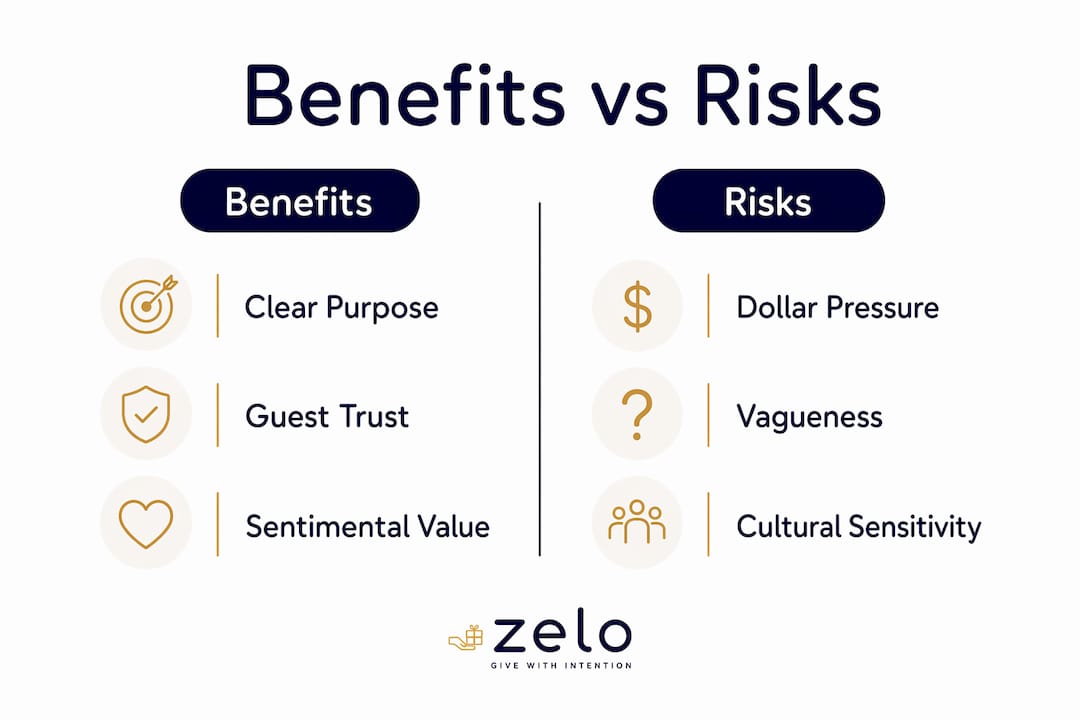
What are the real benefits and risks of transparent cash gifting?
Benefits:
- Guests give with confidence because they know exactly what the contribution supports.
- Hosts receive fewer mismatched physical items they don’t need.
- Clear purpose statements reduce the awkward guessing game around appropriate amounts.
- Transparent communication mitigates suspicion and unfairness perceptions, particularly in early-stage or professional relationships.
Risks:
- Blunt transparency can disrupt what Psychology Today describes as the social “contract of deception” that preserves the sentimental glow of giving. Explicit requests require careful framing to avoid undermining that warmth.
- Guests may feel subtle pressure to contribute even when finances are tight.
- Reciprocity concerns can surface when the fund’s goal is very large or very specific.
The fix is almost always framing. Transparency applied to purpose preserves sentiment; transparency applied to dollar amounts tends to strip it.
Pro Tip: Pair every cash fund with at least one small physical gift option on your registry. It gives guests who prefer tangible giving a comfortable path and signals that no single format is required.
How should you adapt transparency to different guests and U.S. event contexts?
Closer relationships tolerate more candid purpose statements. Formal or collegial guests need softer framing. This isn’t about being less honest; it’s about matching the register of the relationship.

| Guest Type | Recommended Transparency Level | Example Framing |
|---|---|---|
| Close family | High: specific goal, personal story | “We’re saving for IVF — every bit helps us get there.” |
| Close friends | High: named purpose, casual tone | “Contributions go toward our honeymoon in Costa Rica.” |
| Work colleagues | Moderate: general purpose, no dollar cues | “We have a small fund for experiences we’re looking forward to.” |
| Acquaintances | Low: optional mention, registry link only | Registry card with a brief note, no verbal request |
Cultural sensitivity matters in diverse U.S. guest lists. Some guests come from backgrounds where cash gifts are the default and no explanation is needed; others find any mention of money on an invitation uncomfortable. A brief, optional note on the event website handles both: guests who want context find it, and guests who prefer not to engage with it can skip it.
How do you phrase a cash gift request so it feels tasteful?
Lead with purpose, then offer the option. The modern gifting process recommends purpose statements, storytelling, and discreet registry placement to maintain ceremony.
Sample phrases by tone:
- Warm: “Your presence is the greatest gift. If you’d like to contribute something, we’ve set up a small fund toward our first home.”
- Formal: “In lieu of traditional gifts, we welcome contributions to our honeymoon travel fund.”
- Casual: “Honestly? We’re saving for a trip. Chip in if you want — no pressure at all.”
Placement guidance:
- Invitation: A single discreet line or registry card insert. Never list a dollar amount.
- Event website: A dedicated “Registry” or “Gifts” page with the purpose statement and a secure link.
- RSVP page: An optional checkbox or note (“We’ve included a link to our gift fund if you’d like to contribute”).
- In person: Let a close family member or wedding party member mention it casually if guests ask. Hosts should not bring it up themselves.
How do you frame a cash fund so it feels meaningful, not transactional?
Story plus purpose is the combination that protects sentimental value. Verifiable, specific goals generate deeper trust than vague requests. “We’re saving for a down payment on our first home in Austin” lands differently than “We’d appreciate cash gifts.”
Tiered framing helps guests at different comfort levels participate without feeling over- or under-invested:
| Contribution Tier | Label | Example Purpose |
|---|---|---|
| Small | “A small gesture” | Covers one dinner on the honeymoon |
| Mid-range | “A meaningful contribution” | Funds one night of the trip |
| Larger | “A generous gift” | Supports a major experience or goal |
Never attach dollar amounts to these tiers on the invitation itself. The labels exist to signal that any size contribution is welcome, not to set a floor. For hosts who want ideas on personalizing the gifting experience, adding a short personal story to the fund page makes contributions feel like part of the event narrative rather than a financial transaction.
Pro Tip: Write two or three sentences about why the goal matters to you and place them at the top of your fund page. Guests who read it will feel like contributors to your story, not payers of a bill.
What logistics, privacy, and payment steps should hosts get right?
Secure payment processing and clear privacy rules are the practical backbone of transparent cash gifting. Guests need to know their financial information is protected and that their individual contribution amount won’t be announced publicly.
- Use a platform with encrypted, secure checkout so guests never share card details directly with the host.
- Display the fund’s purpose publicly; keep individual contribution amounts private.
- Offer multiple payment paths: platform checkout, bank transfer, or personal check for guests who prefer offline options.
- Confirm every contribution with an automated thank-you message so guests know their gift was received.
U.S. tax note: The IRS annual gift tax exclusion applies to givers, not recipients. For most personal milestone events, cash contributions from guests fall well within standard exclusion limits and require no action from the host. Confirm your specific situation with a tax professional or the IRS gift tax guidance directly.
Pro Tip: Add a one-line privacy assurance to your fund page: “Individual contributions are never shared or displayed publicly.” Guests who are uncertain about contributing often just need that reassurance.
Three event scenarios with scripts and do/don’t guidance
Wedding
Script: “We have everything we need for our home. If you’d like to give a gift, we’ve set up a honeymoon fund — contributions go toward experiences we’ll remember forever.”
- Do place the registry link on your wedding website under a “Registry” tab.
- Don’t mention the fund in the ceremony program or during the reception.
- Do include a physical gift option (even one item) for guests who prefer it.
- Don’t list a contribution amount or a fund total anywhere guests can see it.
Baby shower
Script: “We’re so grateful for your love and support. If you’d like to contribute, we’ve created a fund for [child’s name]'s first experiences — classes, outings, and adventures.”
- Do frame contributions as experiences rather than expenses.
- Don’t use language like “instead of gifts, please give cash” — it sounds transactional.
- Do mix the fund with a small physical registry for guests who enjoy wrapping something.
Milestone birthday
Script: “For my 40th, I’m skipping the stuff and saving for a trip I’ve always wanted. If you want to chip in, there’s a link below — but truly, just being there is enough.”
- Do keep the tone light and personal; milestone birthdays allow more casual framing.
- Don’t send a fund link without a personal note explaining why the goal matters.
- Do acknowledge that some guests will bring a physical gift anyway and receive it graciously.
How can a cash-gifting platform help you practice transparency?
A well-designed platform does most of the transparency work for you by building purpose, privacy, and confirmation into the guest experience. Look for these features:
- Purpose labels: A field where hosts write the fund’s goal in their own words, displayed prominently on the event page.
- Private contribution amounts: Individual amounts visible only to the host, never to other guests.
- Tiered suggestions: Optional contribution amounts guests can select without feeling locked in.
- Secure checkout: Encrypted payment processing that protects guest financial data.
- Automated thank-you messages: Confirmation sent to guests immediately after contributing.
Steps to set up a transparent fund:
- Create the event page and write a one-to-two sentence purpose statement.
- Add a short personal story (two to three sentences) explaining why the goal matters.
- Set privacy rules so individual amounts are hidden from public view.
- Add optional contribution tiers with descriptive labels, not dollar minimums.
- Enable automated confirmation messages so every guest receives an immediate acknowledgment.
- Share the page link on your event website and RSVP page, not in the printed invitation itself.
Collecting cash gifts through a dedicated platform also gives hosts a clear record of contributions, which simplifies thank-you notes and post-event acknowledgment.
Key Takeaways
Transparency in gifting works best when hosts share the purpose of a cash fund clearly, protect individual contribution amounts privately, and adapt their framing to the relationship and cultural context of each guest.
| Point | Details |
|---|---|
| Purpose over price | Tell guests what the fund supports; never disclose a dollar target or individual amounts. |
| Audience-matched framing | Close family and friends accept candid goals; colleagues and acquaintances need softer, optional language. |
| Secure and private logistics | Use encrypted checkout and keep individual contributions visible only to the host. |
| Story-first presentation | A two-to-three sentence personal story on the fund page makes contributions feel meaningful, not transactional. |
| Getzelo as your platform | Getzelo’s event pages combine purpose labels, private contribution settings, and secure checkout to support every transparency best practice in this guide. |
Transparency in gifting is simpler than most hosts expect
Most hosts overthink the ask. They worry that requesting cash will offend guests or signal that the event is about money rather than celebration. The research suggests the opposite: guests who understand why they’re contributing and what their gift supports feel more connected to the event, not less.
The real risk isn’t transparency. It’s vagueness. A fund with no stated purpose forces guests to project their own assumptions onto the request, and those assumptions are rarely as generous as the host’s actual intentions. A single honest sentence about the goal removes that friction entirely.
What actually matters is the framing: purpose-first, story-backed, and free of dollar pressure. That combination keeps the sentiment intact while giving guests the clarity they need to give with confidence.
Getzelo makes transparent cash gifting straightforward
Getzelo is built for exactly the kind of thoughtful, purpose-driven gifting this guide describes. Hosts create a personalized event page, write their goal in their own words, and set privacy controls so individual amounts stay between the host and each guest. Contribution tiers, secure checkout, and automated thank-you messages handle the logistics automatically.

The result is a fund page that feels like part of the celebration, not a payment portal. Guests land on a page that tells them the story behind the goal, offers flexible contribution options, and confirms their gift immediately. No awkward conversations, no public amount displays, no friction.
View a sample Getzelo event page to see how purpose labels, privacy settings, and tiered contributions work together in practice, then create your own event page at getzelo.co.
Useful sources
- The Psychology of Gift-Giving | Psychology Today — explains the neurological and cultural basis for why transparency affects how gifts are received.
- Gifts Come With Strings Attached | Psychology Today — covers the double-edged nature of explicit gifting requests and the importance of framing.
- Mindful Gifting | The Conversation — research-backed case for purpose-driven, low-waste gifting practices.
- Effects of Gifting on Relationship Performance | Journal of the Academy of Marketing Science — academic evidence that transparent communication reduces suspicion and unfairness in gift relationships.
- Why Traceability Matters for Gifts | TheParadise.store — explains how verifiable, specific goals build stronger trust than generic requests.
- Hemp Sourcing Transparency | Coastal Hemp — relevant when hosts consider gifting specialty or CBD products; covers why sourcing transparency matters for ethical gifting.
- Modern Gifting Process Guide | Getzelo Blog — practical wording and workflow recommendations for event hosts.
- The Psychology of Giving | Getzelo Blog — covers how meaning and intent shape the guest experience and reduce contribution anxiety.
Recommended
Enjoyed the article? Share it!